
DNSmasq kann einen Cyberangriff größer als WannaCry und Mirai entfachen
GESCHRIEBEN VON
Andrii Bezverkhyi
CEO & Mitgründer
[post-views]
Oktober 11, 2017 · 4 min zu lesen
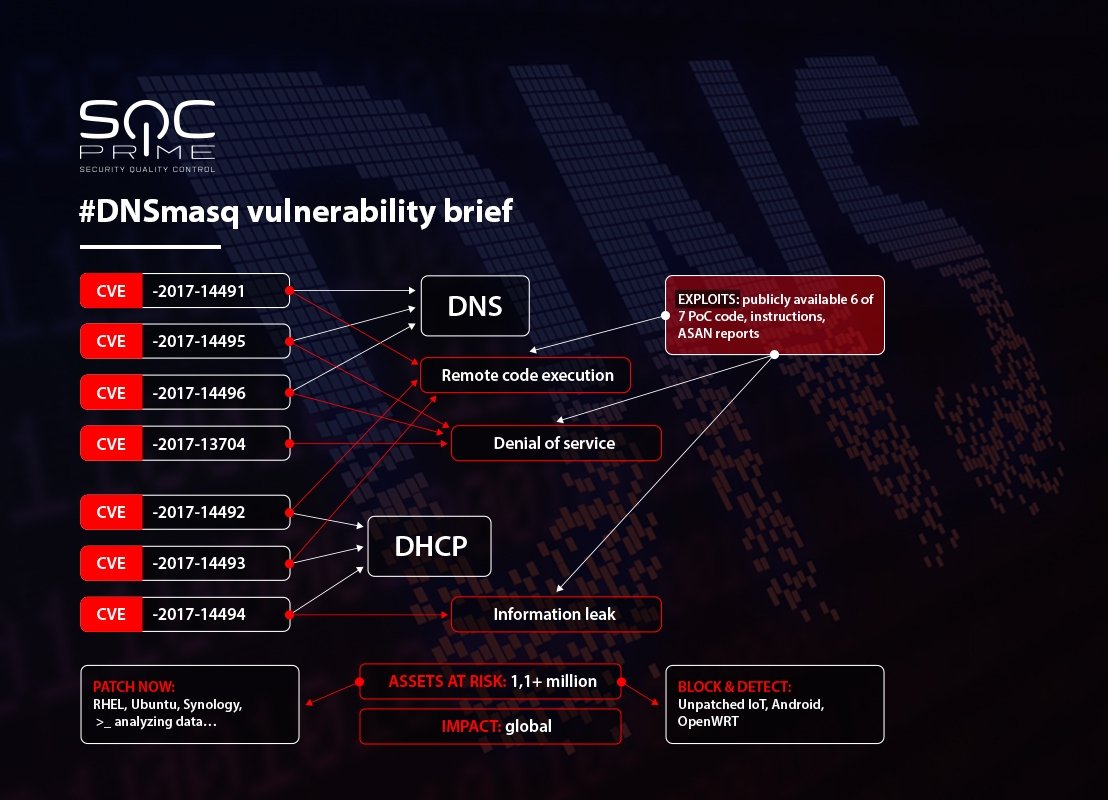
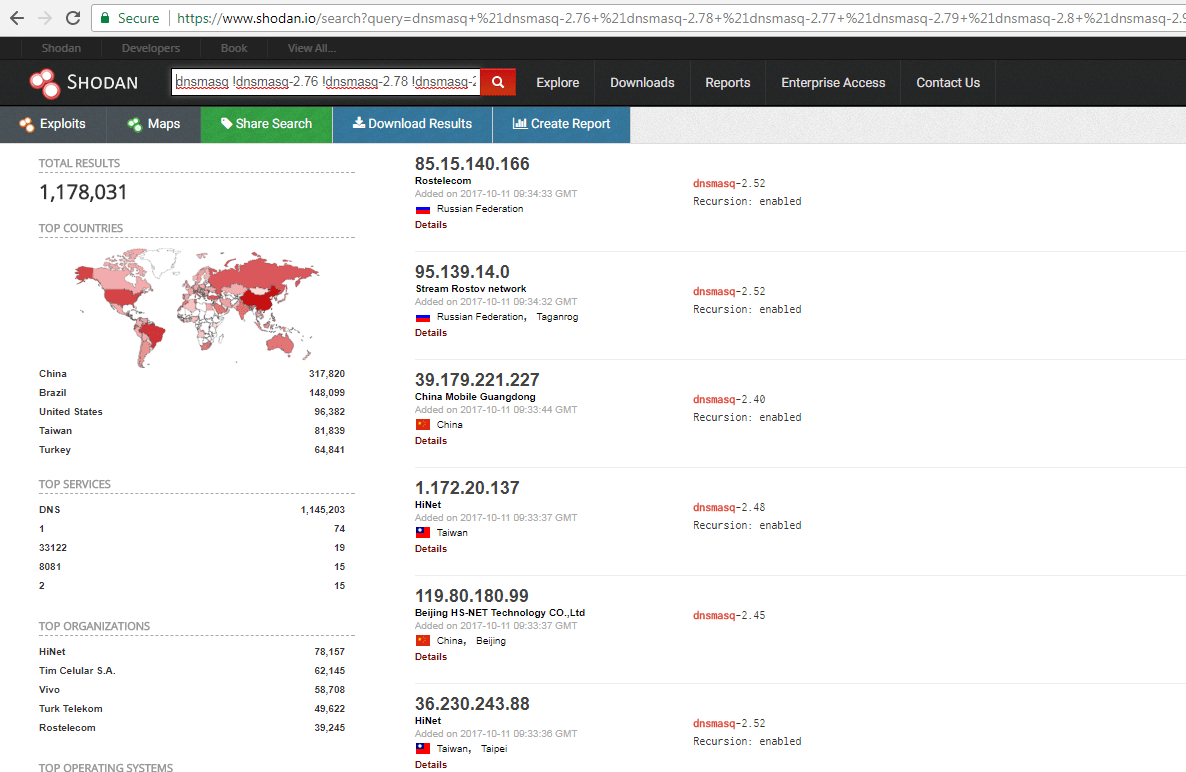
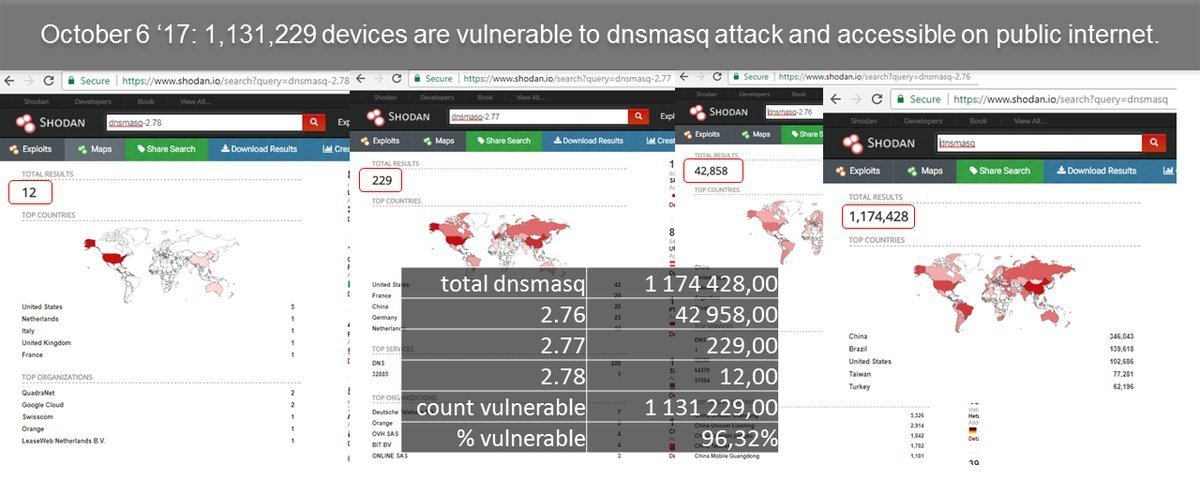
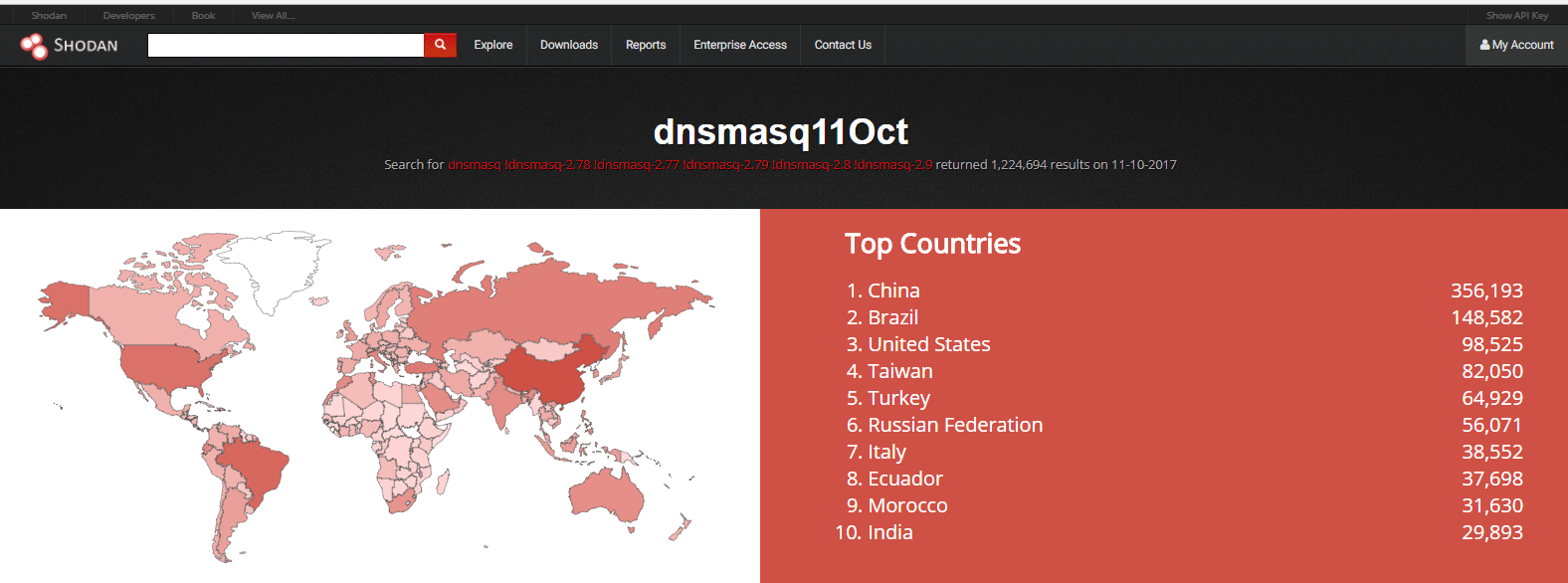
Gute Nachrichten, alle zusammen! Es sind jetzt 10 Tage vergangen, seit Google Security 7 kritische Sicherheitslücken zusammen mit Exploit-Beispielcode für den beliebten dnsmasq-Dienst veröffentlicht hat, und die Welt lebt immer noch, wie wir sie kennen. Wie lange wird das anhalten? Wenn wir uns auf den WannaCry-Ausbruch beziehen, dauert es eine Weile von der Veröffentlichung des öffentlichen Exploits bis zu einem globalen Ausbruch. Oder etwa nicht? Der EternalBlue-Exploit wurde am 7. Januarth zusammen mit anderen „Lost in Translation“-Lecks veröffentlicht, also 5 Monate vor dem WCry-Angriff. Wenn wir uns jedoch an den genauen Zeitplan erinnern, können wir feststellen, dass bis Ende April über 1,7 Millionen Hosts mit dem DoublePulsar-Hintertür-Tracking-Tool infiziert waren, das online durch Scannen von Port 445 oder einfach durch Durchsehen der Shodan-Daten erfasst werden konnte. Ich möchte auf Dan Tentler von PhobosGroup verweisen, der über massive DoublePulsar-Infektionen am 19. April berichteteth, die Scan-Bemühungen initiierte und die Ergebnisse berichtete. Und da WannaCry am 12. Mai zuschlugth vergingen genau 24 Tage von dem Moment der öffentlichen Offenlegung von zehntausenden mit Hintertüren versehenen Maschinen bis zu dem Tag, an dem der Angriff stattfand. Wie hängt dies mit der Dnsmasq-Situation zusammen? Diesmal hatte ich ein wenig Freiheit, ein hübsches Bild zur Beschreibung der Bedrohung zu machen:Mit 3 RCE-Sicherheitslücken müssen wir alle diese Maschinen, auf denen ein ungepatchter dnsmasq ausgeführt wird, als bereits kompromittiert und wahrscheinlich mit einer Hintertür versehen betrachten. Und da wir die Fähigkeit der Gegner gesehen haben, einen globalen WannaCry-Angriff in 24 Tagen auszuführen, können wir vorhersehen, dass etwas Großes und Schlimmes bereits am 26. Oktober losgehen kann. Oder am 27.,th um uns Infosec-Leuten einen weiteren lustigen Freitag zu bescheren. Es kann auch schneller passieren, da, wie man sagt, „Angreifer sich immer weiterentwickeln“. Ein Scan und eine Verifizierung wären nett, um die Hintertür-Hypothese zu bestätigen, aber zuerst lassen Sie uns die Größe des bevorstehenden Desasters messen, indem wir Shodan fragen. Hier ist eine Abfrage, wenn Sie die Genauigkeit überprüfen möchten: https://www.shodan.io/search?query=dnsmasq+!dnsmasq-2.76+!dnsmasq-2.78+!dnsmasq-2.77+!dnsmasq-2.79+!dnsmasq-2.8+!dnsmasq-2.9Ab dem 11. Oktoberthgibt es insgesamt 1.178.031 Geräte, die eine anfällige Version von dnsmasq ausführen, und das ist der Fall, wenn man Version 2.76 nicht als anfällig oder wahrscheinlich für einen groß angelegten Angriff ins Visier nehme. Ich habe die Zahlen zum Patchen bereits am 6. Oktober gemeldetth und die Anzahl der anfälligen Geräte betrug 1.131.229, sodass die Anzahl der ungepatchten Geräte, die von Shodan entdeckt werden, weiter steigt!Vielleicht sind die Warnungen von Google Security auf taube Ohren gestoßen? Es mag so scheinen, aber wenn wir lange Patch-Management-Zyklen in Unternehmen (existieren sie überhaupt für IoT?) und die große Anzahl von Android-Geräten in Betracht ziehen, die nicht unterstützt werden, erscheint die Situation vernünftig. Ist die Auswirkung global? Antworten finden Sie in diesem Bericht von Shodan:Warum also erwähnen wir Mirai? Es war ein berüchtigtes Botnetz, das aus dem Scannen und dem Aufbau einer Bot-Armee unsicherer IoT-Geräte bestand, die Klartextprotokolle wie Telnet und festcodierte Anmeldeinformationen nutzten. Ein Angreifer mit solchen Fähigkeiten wird wenig Mühe haben, von einem Brute-Force-Angriff zu einem RCE mit öffentlich verfügbarem Exploit-Code aufzurüsten. Wenn jedoch bis zum 27. Oktober nichts passiert, würde das bedeuten, dass dnsmasq von APT-Akteuren genutzt wird, die darauf bedacht sind, ihre Positionen durch Schaffung von Beständigkeit (siehe Wege dazu bei MITRE ATT&CK) zu sichern und im Verborgenen zu arbeiten. Wenn wir einen plötzlichen Anstieg bei der Behebung von dnsmasq feststellen, würde ich überall APT vermuten. Es ist ein lukrativer Weg hinein (und hinaus) für die APT-Akteure, da DNS-Traffic immer noch unsicher und unkontrolliert in den meisten Organisationen ist und leicht für Command & Control, Lieferung und Datenausleitung ausgenutzt werden kann. Komme, was da wolle, blockiere einfach diese Vermögenswerte, um auf der sicheren Seite zu sein und setzen Sie einige Erkennungskontrollen ein, denn es gibt viele andere wunderbare Dinge in der Cybersicherheit zu tun. Und wenn Sie stolzer Besitzer eines dnsmasq-Geräts im Rahmen Ihres IoT-Projekts bei der Arbeit oder als heimischer Router sind – aktualisieren Sie diese Firmware noch heute!
/Bleiben Sie sicher
P.S. Wir haben gerade das Cross-Checking aller 1.17K+ Geräte mit unserem Tor-Feed abgeschlossen und nur einen Treffer erzielt. Wir haben begonnen, die IP-Adressen mit IPVoid und VirusTotal zu überprüfen und haben bereits einige IP-Adressen als bösartig bestätigt. Updates stehen an.
Gefällt es Ihnen, teilen Sie es mit Ihren Kollegen.
Treten Sie der Detection as Code-Plattform von SOC Prime bei
um die Sichtbarkeit in Bedrohungen zu verbessern, die für Ihr Unternehmen am relevantesten sind. Um Ihnen den Einstieg zu erleichtern und sofortigen Nutzen zu bieten, buchen Sie jetzt ein Treffen mit SOC Prime-Experten.
This website uses cookies (small text files that are stored by the web browser on the user's device) to improve the user experience while you navigate through the website for the statistical analysis of traffic and to adapt the content of the website to your individual needs. It also lets us improve your overall experience of the website. These cookies will only be stored in your browser with your consent.
However, if you would like to, you can opt-out of these cookies in your browser settings at any time. But opting out of some of these cookies may have a negative impact on your viewing experience. More information can be found in our Cookie Policy, and for a detailed list of the cookies we use, see our Cookie Settings.
Cannot be switched off in our systems. They are usually only set in
response to actions made by you which amount to a request for services,
such as setting your privacy preferences, logging in or filling in forms.
You can set your browser to block or alert you about these cookies, but
some parts of the site will not then work. These cookies do not store any
personally identifiable information.
Name
Descripiton
PHPSESSID
Preserves user session state across page requests.
Cookie generated by applications based on the PHP
language. This is a general purpose identifier used
to maintain user session variables. It is normally
a random generated number, how it is used can be
specific to the site, but a good example is maintaining
a logged-in status for a user between pages.
sp_i
Used to store information about authenticated User.
sp_r
Used to store information about authenticated User.
sp_a
Used to store information about authenticated User.
Performance Cookies
These cookies allow us to count visits and traffic sources so we can
measure and improve the performance of our site. They help us to know
which pages are the most and least popular and see how visitors move
around the site.
All information these cookies collect is aggregated
and therefore anonymous. If you do not allow these cookies we will not
know when you have visited our site, and will not be able to monitor
its performance.
Name
Descripiton
tuuid
Collects anonymous data related to the user's visits to the website, such as the
number of visits, average time spent on the website and what pages have been
loaded.
tuuid_last_update
Collects anonymous data related to the user's visits to the website, such as the
number of visits, average time spent on the website and what pages have been
loaded.
um
Collects anonymous data related to the user's visits to the website, such as the
number of visits, average time spent on the website and what pages have been
loaded.
umeh
Collects anonymous data related to the user's visits to the website, such as the
number of visits, average time spent on the website and what pages have been
loaded.
na_sc_x
Used by the social sharing platform AddThis to keep a record of parts of the
site that has been visited in order to recommend other parts of the site.
APID
Collects anonymous data related to the user's visits to the website.
IDSYNC
Collects anonymous data related to the user's visits to the website.
_cc_aud
Collects anonymous statistical data related to the user's website visits, such
as the number of visits, average time spent on the website and what pages have
been loaded. The purpose is to segment the website's users according to factors
such as demographics and geographical location, in order to enable media and
marketing agencies to structure and understand their target groups to enable
customised online advertising.
_cc_cc
Collects anonymous statistical data related to the user's website visits, such
as the number of visits, average time spent on the website and what pages have
been loaded. The purpose is to segment the website's users according to factors
such as demographics and geographical location, in order to enable media and
marketing agencies to structure and understand their target groups to enable
customised online advertising.
_cc_dc
Collects anonymous statistical data related to the user's website visits, such
as the number of visits, average time spent on the website and what pages have
been loaded. The purpose is to segment the website's users according to factors
such as demographics and geographical location, in order to enable media and
marketing agencies to structure and understand their target groups to enable
customised online advertising.
_cc_id
Collects anonymous statistical data related to the user's website visits, such
as the number of visits, average time spent on the website and what pages have
been loaded. The purpose is to segment the website's users according to factors
such as demographics and geographical location, in order to enable media and
marketing agencies to structure and understand their target groups to enable
customised online advertising.
dpm
Via a unique ID that is used for semantic content analysis, the user's
navigation on the website is registered and linked to offline data from surveys
and similar registrations to display targeted ads.
acs
Collects anonymous data related to the user's visits to the website, such as the
number of visits, average time spent on the website and what pages have been
loaded, with the purpose of displaying targeted ads.
clid
Collects anonymous data related to the user's visits to the website, such as the
number of visits, average time spent on the website and what pages have been
loaded, with the purpose of displaying targeted ads.
KRTBCOOKIE_#
Registers a unique ID that identifies the user's device during return visits
across websites that use the same ad network. The ID is used to allow targeted
ads.
PUBMDCID
Registers a unique ID that identifies the user's device during return visits
across websites that use the same ad network. The ID is used to allow targeted
ads.
PugT
Registers a unique ID that identifies the user's device during return visits
across websites that use the same ad network. The ID is used to allow targeted
ads.
ssi
Registers a unique ID that identifies a returning user's device. The ID is used
for targeted ads.
_tmid
Registers a unique ID that identifies the user's device upon return visits. The
ID is used to target ads in video clips.
wam-sync
Used by the advertising platform Weborama to determine the visitor's interests
based on pages visits, content clicked and other actions on the website.
wui
Used by the advertising platform Weborama to determine the visitor's interests
based on pages visits, content clicked and other actions on the website.
AFFICHE_W
Used by the advertising platform Weborama to determine the visitor's interests
based on pages visits, content clicked and other actions on the website.
B
Collects anonymous data related to the user's website visits, such as the number
of visits, average time spent on the website and what pages have been loaded.
The registered data is used to categorise the users' interest and demographical
profiles with the purpose of customising the website content depending on the
visitor.
1P_JAR
These cookies are used to gather website statistics, and track conversion
rates.
APISID
Google set a number of cookies on any page that includes a Google reCAPTCHA.
While we have no control over the cookies set by Google, they appear to include
a mixture of pieces of information to measure the number and behaviour of Google
reCAPTCHA users.
HSID
Google set a number of cookies on any page that includes a Google reCAPTCHA.
While we have no control over the cookies set by Google, they appear to include
a mixture of pieces of information to measure the number and behaviour of Google
reCAPTCHA users.
NID
Google set a number of cookies on any page that includes a Google reCAPTCHA.
While we have no control over the cookies set by Google, they appear to include
a mixture of pieces of information to measure the number and behaviour of Google
reCAPTCHA users.
SAPISID
Google set a number of cookies on any page that includes a Google reCAPTCHA.
While we have no control over the cookies set by Google, they appear to include
a mixture of pieces of information to measure the number and behaviour of Google
reCAPTCHA users.
SID
Google set a number of cookies on any page that includes a Google reCAPTCHA.
While we have no control over the cookies set by Google, they appear to include
a mixture of pieces of information to measure the number and behaviour of Google
reCAPTCHA users.
SIDCC
Security cookie to protect users data from unauthorised access.
SSID
Google set a number of cookies on any page that includes a Google reCAPTCHA.
While we have no control over the cookies set by Google, they appear to include
a mixture of pieces of information to measure the number and behaviour of Google
reCAPTCHA users.
__utmx
This cookie is associated with Google Website Optimizer, a tool designed to help
site owners improve their wbesites. It is used to distinguish between two
varaitions a webpage that might be shown to a visitor as part of an A/B split
test. This helps site owners to detemine which version of a page performs
better, and therefore helps to improve the website.
__utmxx
This cookie is associated with Google Website Optimizer, a tool designed to help
site owners improve their wbesites. It is used to distinguish between two
varaitions a webpage that might be shown to a visitor as part of an A/B split
test. This helps site owners to detemine which version of a page performs
better, and therefore helps to improve the website.
Functional Cookies
These cookies enable the website to provide enhanced functionality and personalisation.
They may be set by us or by third party providers whose services we have added to our
pages.
If you do not allow these cookies then some or all of these services may not function
properly.
Name
Descripiton
_hjid
Hotjar cookie. This cookie is set when the customer first lands on a page with
the Hotjar script. It is used to persist the random user ID, unique to that site
on the browser. This ensures that behavior in subsequent visits to the same site
will be attributed to the same user ID.
_hjIncludedInSample
This cookie is associated with web analytics functionality and services from Hot
Jar, a Malta based company. It uniquely identifies a visitor during a single
browser session and indicates they are included in an audience sample.
intercom-id-[xxx]
This cookie is used by Intercom as a session so that users can continue a chat
as they move through the site.
intercom-session-[xxx]
Used to keeping track of sessions and remember logins and conversations.
demdex
Via a unique ID that is used for semantic content analysis, the user's
navigation on the website is registered and linked to offline data from surveys
and similar registrations to display targeted ads.
CookieConsent
Stores the user's cookie consent state for the current domain.
__cfduid
Used by the content network, Cloudflare, to identify trusted web traffic.
ss
These cookies enable the website to provide enhanced functionality and
personalisation . They may be set by us or by third party providers whose
services we have added to our pages. These services may include the Live Chat
facility, Contact Us form(s), the Product Quotation forms and submission
process, and the Email Newsletter sign up functionality .
Targeting Cookies
These cookies may be set through our site by our advertising partners.
They may be used by those companies to build a profile of your interests
and show you relevant adverts on other sites.
They do not store directly personal information, but are based on uniquely
identifying your browser and internet device. If you do not allow these cookies,
you will experience less targeted advertising.
Name
Descripiton
_ga
This cookie name is asssociated with Google Universal Analytics - which is a
significant update to Google's more commonly used analytics service. This cookie
is used to distinguish unique users by assigning a randomly generated number as
a client identifier. It is included in each page. Registers a unique ID that is
used to generate statistical data on how the visitor uses the website. request
in a site and used to calculate visitor, session and campaign data for the sites
analytics reports. By default it is set to expire after 2 years, although this
is customisable by website owners.
_gat
Used by Google Analytics to throttle request rate. This cookie name is
associated with Google Universal Analytics, according to documentation it is
used to throttle the request rate - limiting the collection of data on high
traffic sites. It expires after 10 minutes.
_gid
This cookie name is asssociated with Google Universal Analytics. This appears to
be a new cookie and as of Spring 2017 no information is available from Google.
It appears to store and update a unique value for each page visited. Registers a
unique ID that is used to generate statistical data on how the visitor uses the
website.
IDE
Used by Google DoubleClick to register and report the website user's actions
after viewing or clicking one of the advertiser's ads with the purpose of
measuring the efficacy of an ad and to present targeted ads to the user.
r/collect
Used by Google DoubleClick to register and report the website user's actions
after viewing or clicking one of the advertiser's ads with the purpose of
measuring the efficacy of an ad and to present targeted ads to the user.
test_cookie
Used to check if the user's browser supports cookies.
collect
Used to send data to Google Analytics about the visitor's device and behaviour.
Tracks the visitor across devices and marketing channels.
ads/user-lists/#
These cookies may be set through our site by our advertising partners. They may
be used by those companies to build a profile of your interests and show you
relevant adverts on other sites.
c
Registers anonymised user data, such as IP address, geographical location,
visited websites, and what ads the user has clicked, with the purpose of
optimising ad display based on the user's movement on websites that use the same
ad network.
khaos
Registers anonymised user data, such as IP address, geographical location,
visited websites, and what ads the user has clicked, with the purpose of
optimising ad display based on the user's movement on websites that use the same
ad network.
put_#
Registers anonymised user data, such as IP address, geographical location,
visited websites, and what ads the user has clicked, with the purpose of
optimising ad display based on the user's movement on websites that use the same
ad network.
rpb
Registers anonymised user data, such as IP address, geographical location,
visited websites, and what ads the user has clicked, with the purpose of
optimising ad display based on the user's movement on websites that use the same
ad network.
rpx
Registers anonymised user data, such as IP address, geographical location,
visited websites, and what ads the user has clicked, with the purpose of
optimising ad display based on the user's movement on websites that use the same
ad network.
tap.php
Registers anonymised user data, such as IP address, geographical location,
visited websites, and what ads the user has clicked, with the purpose of
optimising ad display based on the user's movement on websites that use the same
ad network.