Follow
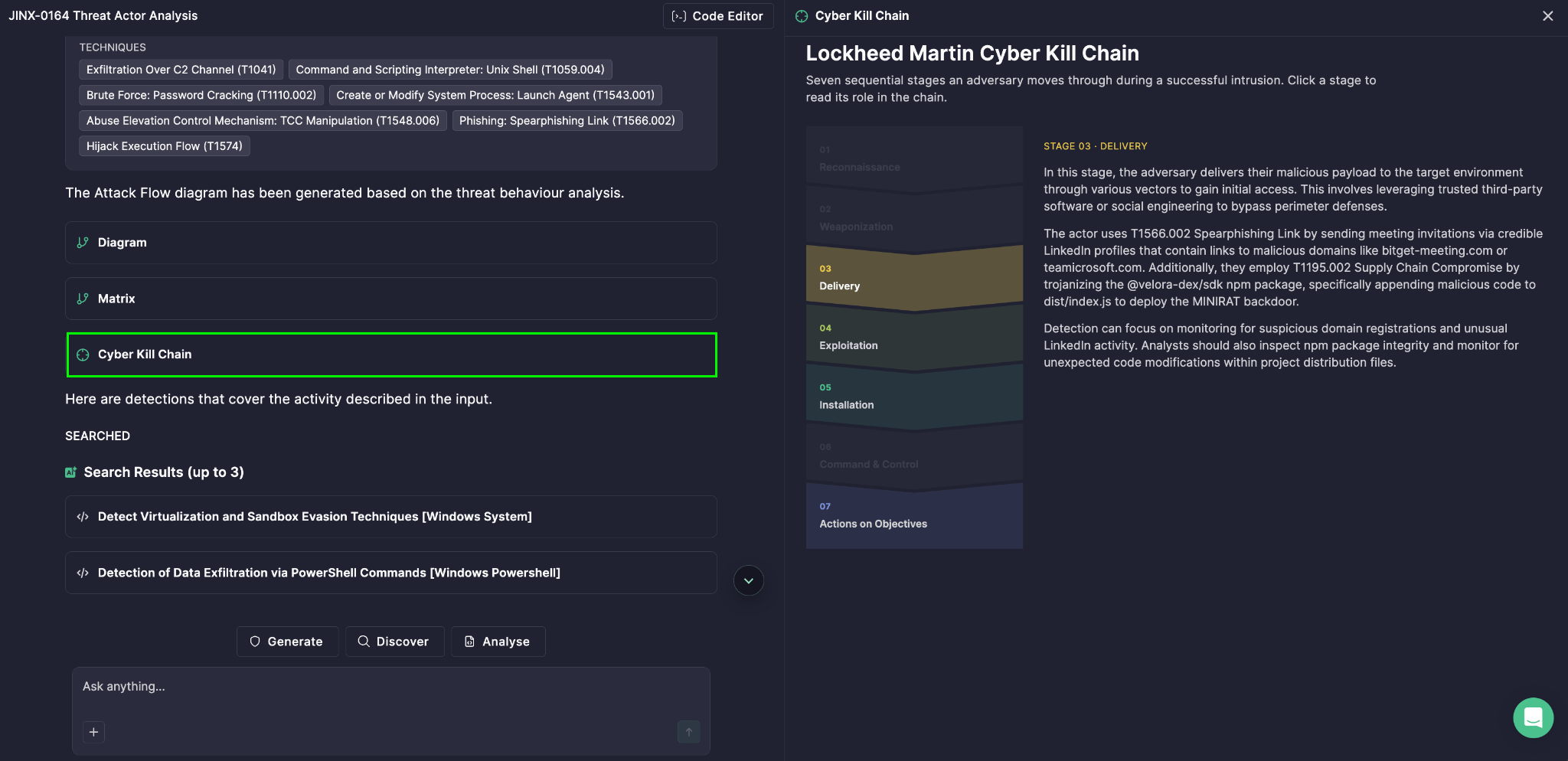
 Understanding how an attacker moves through your environment matters just as much as knowing that they got in. That’s why Prime Architect’s Agentic Threat Research module visualizes attacks using the Cyber Kill Chain — generated automatically as part of Deep Threat Research analysis, giving your team a clear, stage-by-stage map of adversary behavior built directly from the threat report you provide.
Understanding the Framework
The Cyber Kill Chain is a model developed by Lockheed Martin that describes the sequence of stages an attacker moves through during a successful intrusion. The concept borrows its name from military terminology — a “kill chain” describes the structure of an attack, from target identification to engagement — and was adapted for cybersecurity to structure the full lifecycle of an attack, from initial reconnaissance to the achievement of the adversary’s ultimate objective.
The core value of the Lockheed Martin Cyber Kill Chain lies in a simple but powerful idea: an intrusion is not a single event, it’s a chain of dependent steps. If defenders can detect or disrupt the attacker at any link in that chain, the entire intrusion can be stopped before real damage occurs. This reframes defense from “prevent every possible attack” to “break the chain at the weakest link the attacker depends on” — a far more achievable and measurable goal.
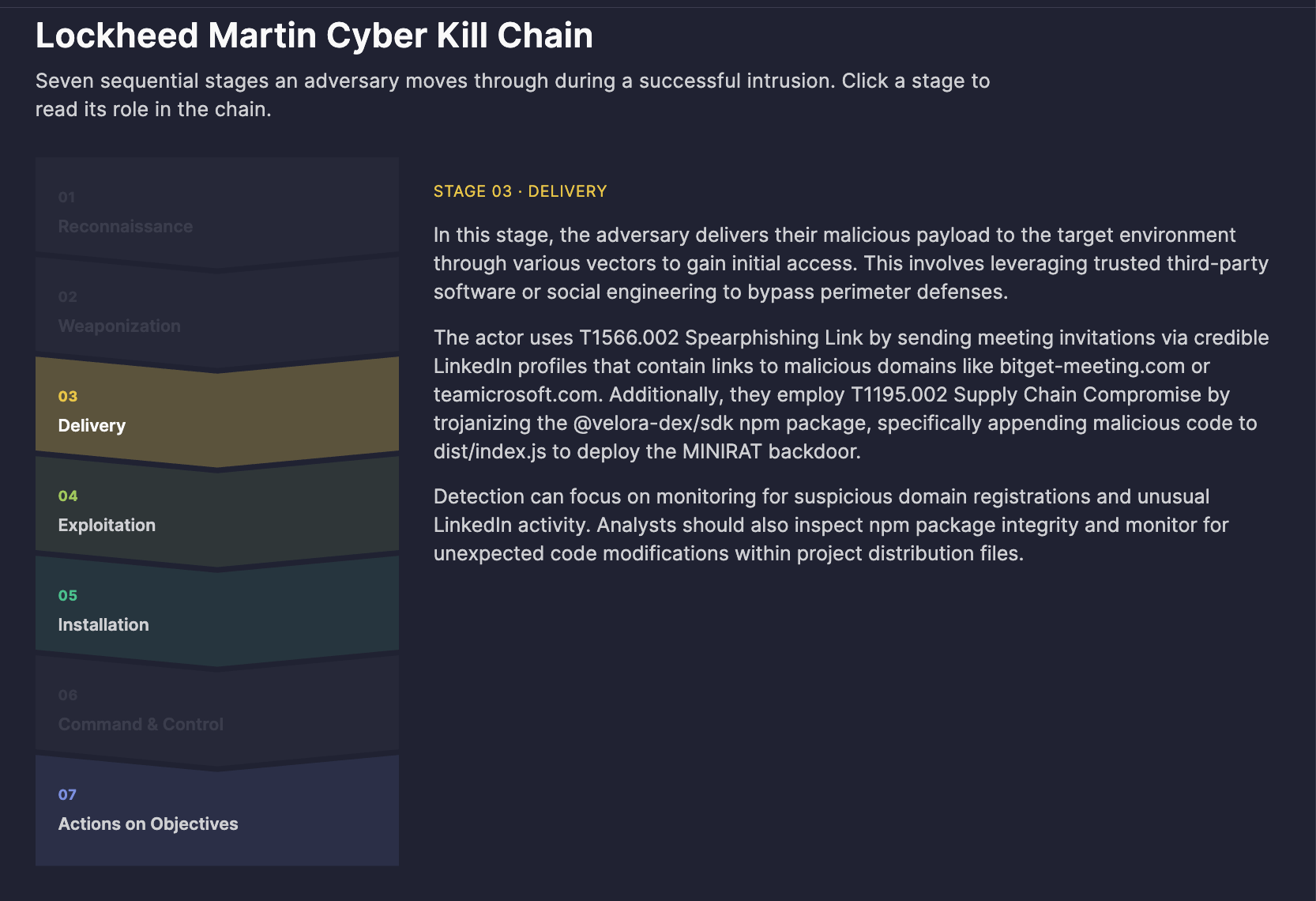
The Cyber Kill Chain includes seven stages, each representing a distinct phase of the intrusion lifecycle:
- Reconnaissance — the attacker researches and identifies potential targets
- Weaponization — a malicious payload is crafted or configured
- Delivery — the payload is transmitted into the target environment
- Exploitation — a vulnerability is triggered to achieve code execution
- Installation — the attacker establishes persistence
- Command & Control — a communication channel is established with the compromised system
- Actions on Objectives — the attacker achieves their ultimate goal (data theft, disruption, destruction, etc.)
In Prime Architect, the Cyber Kill Chain visualizes these seven stages against the specific behavior of the analyzed threat, so instead of reading a dense narrative report, analysts can instantly see where a given threat sits within this widely recognized framework. Each stage is interactive — clicking it reveals its role in the chain and the typical adversary tradecraft associated with it, in the context of the threat being analyzed.
Putting the Framework to Work
1. Gap analysis and threat coverage assessment
By mapping a threat’s observed behavior onto the kill chain, teams can immediately see their threat coverage — which stages are well-monitored and which represent blind spots. This turns a static report into an actionable defense-planning tool.
2. Detection engineering prioritization
Knowing exactly which stage lacks visibility helps detection engineers prioritize new rules and analytics where they’ll have the most impact, rather than building detections evenly (and inefficiently) across the entire attack surface.
3. Incident response and triage
During live investigations, mapping observed indicators to a kill-chain stage helps responders quickly estimate how far an intrusion has progressed — informing urgency and containment strategy.
4. Security awareness and reporting
The visual, stage-based format makes it easier to communicate attack narratives to non-technical stakeholders and leadership, since the model is an industry standard many already recognize.
5. Control investment justification
Recurring gaps at the same stage across multiple analyzed threats can justify budget for specific control investments (e.g., email filtering for Delivery, EDR for Installation).
How to Generate It
- Open Prime Architect and go to the Agentic Threat Research mode.
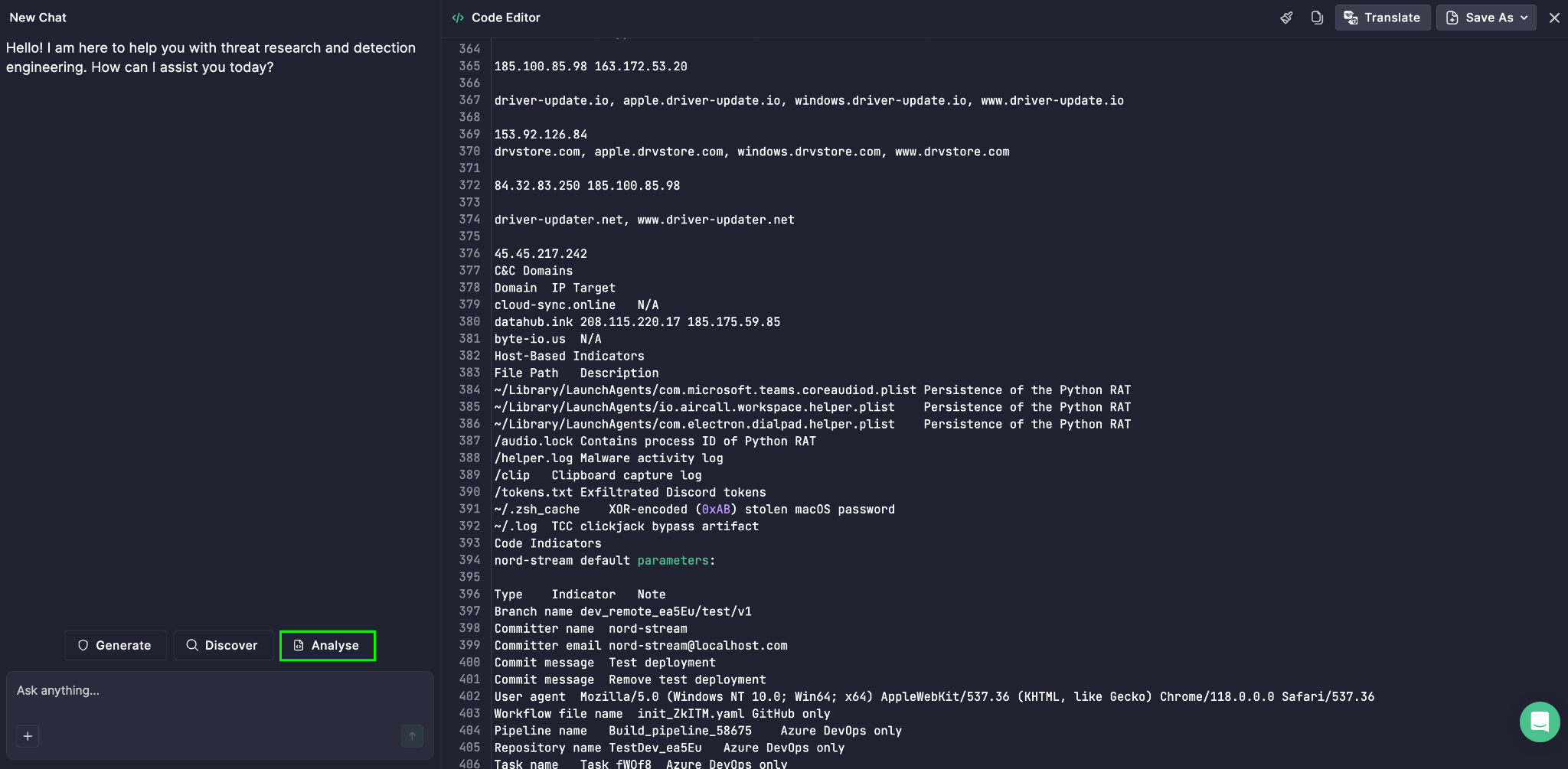
- Click Code Editor in the upper-right corner and paste the text of your threat report.
- Select Analyze.
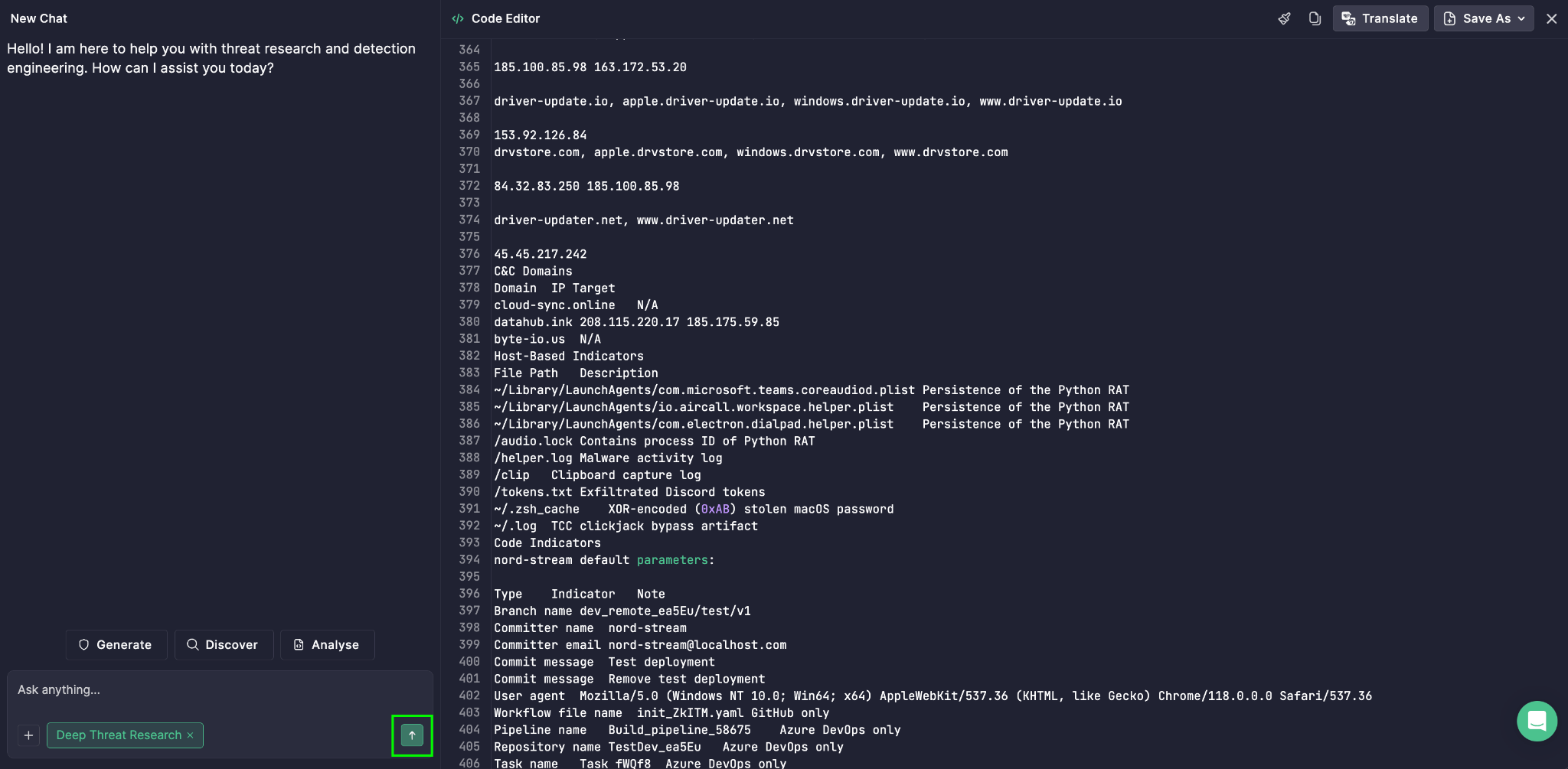
- Choose Deep Threat Research from the list.
- Click the Enter icon to run the analysis.
The Cyber Kill Chain then appears alongside other outputs, giving your team a complete, multi-angle view of the threat.