Follow
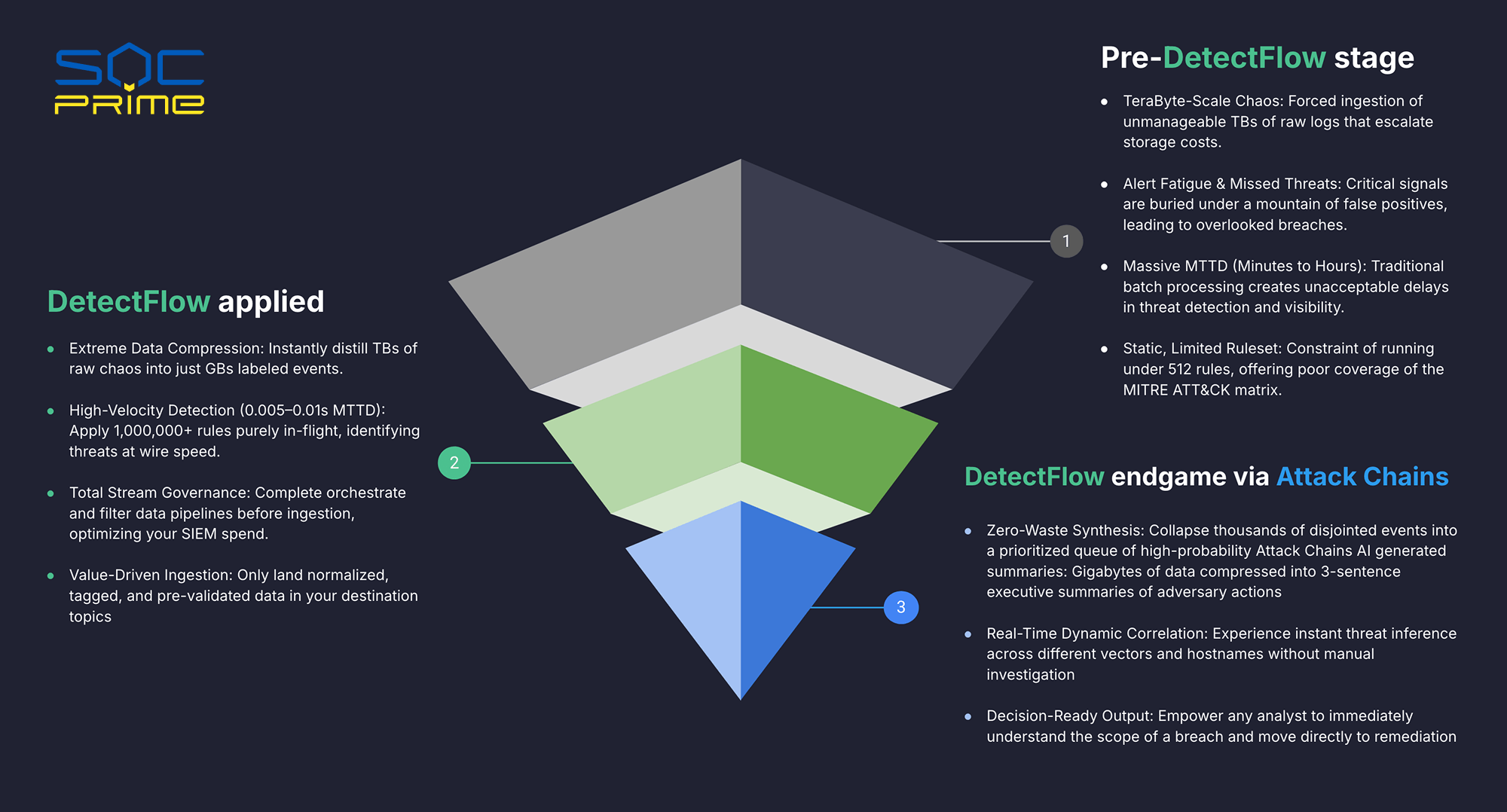
 The Problem: Achieving Threat Detections at Scale
At SOC Prime, we have spent over a decade making detection engineering easier for organizations of every size. Each year, as threats multiply and environments grow more complex, the traditional approach puts SOC Managers in an impossible position — responsible for coverage they cannot achieve with the tools and team they have. DetectFlow offers a path to deploying detections at scale without the engineering overhead. Here is what it solves:
- Your team is drowning in noise, not finding threats: False positives overwhelm analysts and real signals get missed. Alert fatigue isn’t a people problem, it’s a systems problem
- Your detection coverage has hard limits you can’t engineer around: Running under 512 rules means your team has blind spots across the MITRE ATT&CK matrix that no amount of headcount can close
- By the time your team sees a threat, the attacker has already moved: Batch processing creates detection delays measured in minutes to hours, turning a containable incident into a breach
- Your SIEM budget is consumed by data you never needed: Forced ingestion of raw logs at terabyte scale drives storage costs that are impossible to justify to leadership
DetectFlow Applied: Cut Costs and add Speed
DetectFlow fundamentally changes the economics and speed of threat detection. Rather than ingesting raw chaos and sorting it out later, DetectFlow:
- compresses terabytes of raw log data into gigabytes of clean, labeled events (instantly, before anything touches your SIEM).
- detection happens in-flight, at wire speed, applying 50,000+ in real time and driving mean time to detect down to 0.005–0.01 seconds
- the entire data pipeline is governed and filtered before ingestion, so your SIEM only receives normalized, tagged, and pre-validated events resulting in dramatic optimization of your SIEM spend: you’re paying to store and analyze signal, not noise.
The Endgame: Attack Chains That Tell the Full Story
Where DetectFlow truly separates itself is in how it surfaces what matters. Instead of handing analysts thousands of disjointed, low-context alerts to manually correlate, DetectFlow:
- collapses that noise into a prioritized queue of high-probability Attack Chains, complete with AI-generated executive summaries that condense gigabytes of adversary activity into a clear brief.
- Threat inference happens in real time, automatically correlating activity across different vectors and hostnames without requiring any manual investigation.
- The output isn’t a list of alerts: it’s a decision. Any analyst, regardless of experience level, can immediately understand the full scope of a breach and move directly to remediation.
To learn more about DetectFlow head to our overview page.
FAQ
How does DetectFlow reduce SIEM costs?
DetectFlow sits upstream of your SIEM, processing raw event streams before they are ever ingested. It compresses terabytes of raw log data down to roughly 7% of the original volume, filtering out the noise and passing only normalized, threat-tagged events into your SIEM. The result is that your SIEM licensing and storage costs are calculated against signal, not raw volume. For organizations ingesting at scale, that shift alone can be the difference between a sustainable security budget and one that is impossible to defend to a CFO.
What is MTTD and how does DetectFlow improve it?
MTTD (Mean Time to Detect) is the measure of how long it takes your team to identify an active threat after it begins. Traditional SIEM architectures rely on batch processing, which means detection queries run on a delay, often 15 minutes or more after an event occurs. DetectFlow applies detection rules in real time, directly against the live data stream, reducing MTTD to between 0.005 and 0.01 seconds. In practical terms, that is the difference between catching an attacker in the first move and discovering a breach after lateral movement has already occurred.
Why can’t we just add more detection rules to our SIEM?
Most enterprise SIEMs have a hard operational ceiling on how many rules can run simultaneously. Microsoft Sentinel, for example, caps at 512. Beyond the rule limit, every additional rule adds query overhead, slows detection, and increases costs. DetectFlow runs detection at the pipeline layer using Apache Flink, where it can apply tens of thousands of Sigma rules simultaneously without those constraints. That is what allows your team to close MITRE ATT&CK coverage gaps that are simply not addressable inside a SIEM architecture.
Does DetectFlow replace our existing SIEM?
No. DetectFlow integrates with your existing SIEM, it does not replace it. It sits in the Kafka pipeline layer before ingestion, and your SIEM receives cleaner, pre-enriched, threat-tagged events through the same connectors it already uses. Your analysts continue working in familiar dashboards. The change they notice is better data quality, fewer false positives, and faster investigations, not a new tool to learn.
What does “Attack Chains” mean and why does it matter for my team?
Attack Chains is how DetectFlow surfaces correlated threats rather than individual alerts. Instead of passing thousands of isolated events to your analysts for manual investigation, DetectFlow uses AI to collapse related activity across different vectors and hostnames into a single prioritized queue, with a three-sentence executive summary of what the adversary is doing. For a SOC Manager, that means your team is triaging a coherent story about an attack in progress, not a pile of disconnected signals that require hours of investigation before the picture becomes clear.