Follow
 The trade-off nobody wants to make
Anyone who has worked on SOC and SIEM projects long enough has watched the same decision play out in budget meetings again and again. Security teams are pushed into a choice that has nothing to do with security engineering and everything to do with invoices.
Option one: drop log sources. Cut DNS. Cut endpoint process telemetry. Cut cloud audit trails, or sample them down to something the license can absorb. The team survives the budget, and the detection surface quietly shrinks. Every dropped source is a blind spot that an adversary does not have to work around, because it was never watched in the first place.
Option two: keep everything. Stream raw telemetry into SIEMs, Data Lakes, and AI agents, and accept that the bill grows in direct proportion to how much the business logs. Cloud migration, Kubernetes, identity providers, SaaS sprawl — every one of them adds volume, and none of them asks whether the security budget grew this year.
Neither option is a strategy. They are both consequences of the same architectural assumption: that detection happens after storage. That assumption is now the single largest cost driver in the modern SOC, and it is the one we set out to remove.
Today we can share validated ROI on a third approach: putting a full threat detection engine inside the data pipeline, before the expensive tiers ever see the data.
What Prime Detect actually does
SOC Prime Detect evaluates 100% of your streaming telemetry at wire speed. Not a sample. Not a filtered subset chosen by a cost-control rule six months ago that nobody has revisited since. All of it, as it moves.
It does this by applying curated Sigma logic at the pipeline layer — the transport stage between your collectors and your destinations. Three things follow from that placement:
Tier 1 — noise reduction. Prime Detect filters out 93% of raw log noise before it reaches a paid destination. Successful routine authentications, chatty process telemetry, health checks, the enormous background hum that every enterprise environment produces and no analyst has ever opened. The events are evaluated against detection logic first, then discarded or routed cheaply, rather than being paid for at premium ingest rates on the chance they might matter later.
Tier 2 — correlation. Isolated matches are not detections. Prime Detect uses Sigma Correlations, expressed as Higher Order Sigma rules, to assemble individual matches into attack chains across sources and across time. This is where a single suspicious LDAP query and an unusual service creation stop being two low-confidence events and become one high-confidence sequence.
Tier 3 — signal delivery. What reaches the top of the stack is compressed down to 7 PPM — 0.000007 of the original stream. That is the material handed to Tier 3 AI agents: seven events per million, already correlated, already contextualized, already worth reasoning about.
The key point is that nothing is discarded before it is examined. Traditional cost control drops data blind. Prime Detect inspects everything and forwards only what earns its place downstream.
The numbers, as measured with Enterprise customers
The table below shows validated savings across ingest volumes from 100 GB/day to 10 TB/day, broken out by where the cost lands in the stack.
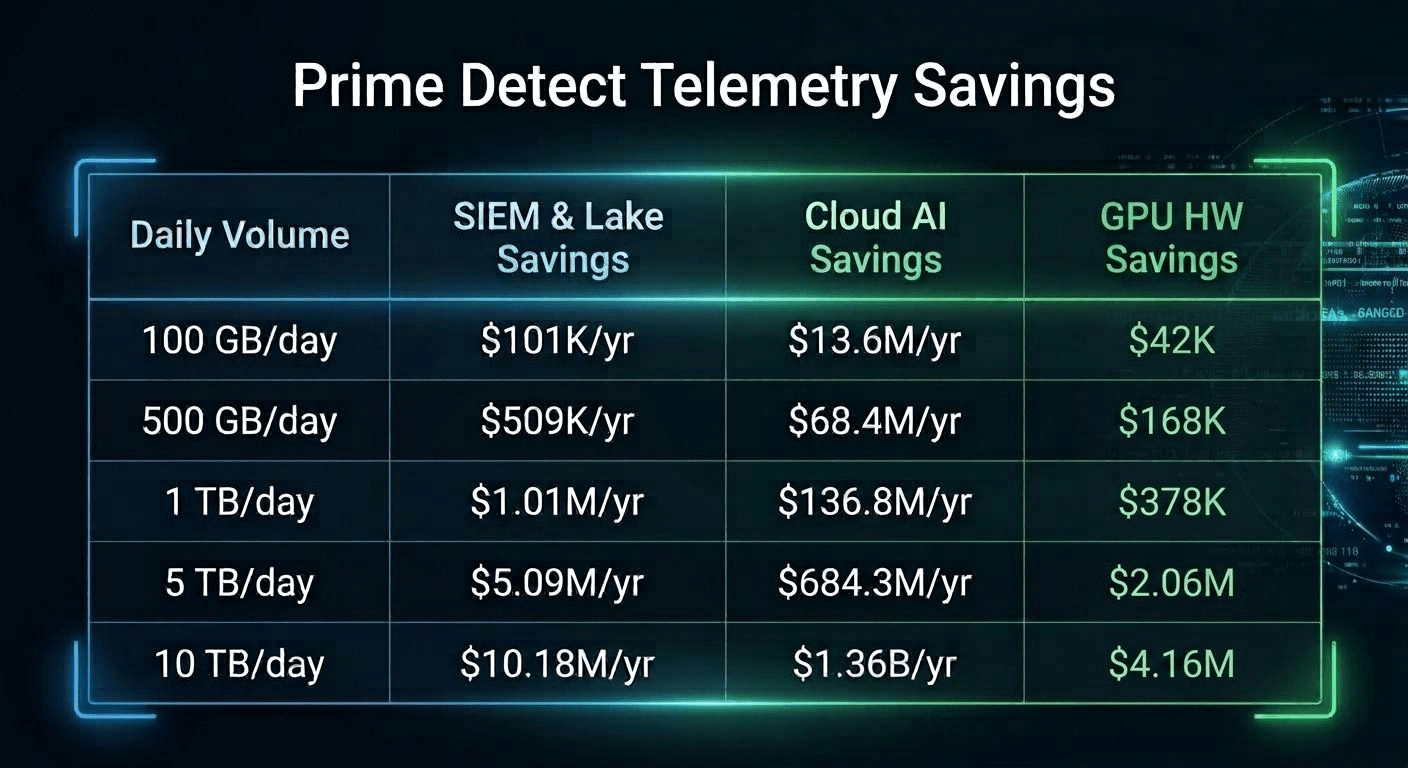
Three separate cost lines are worth reading carefully, because they behave very differently.
SIEM and Data Lake savings are the most familiar. They scale linearly with volume and they are the ones most security leaders already track. At 1 TB/day, a 93% reduction in what reaches the paid tier is worth roughly a million dollars a year. At 10 TB/day it is worth ten.
Cloud AI savings are where the arithmetic becomes genuinely uncomfortable for anyone planning an AI SOC. Token costs scale with the volume of text a model is asked to read. Pointing an LLM at raw telemetry means paying for every heartbeat and every successful login, at inference prices, forever. The gap between reasoning over a raw stream and reasoning over a 7 PPM signal is the difference between a line item and an impossibility. At 1 TB/day, that difference is $136.8M a year.
GPU hardware savings apply to teams running models on their own infrastructure. The saving is smaller in absolute terms but structurally important: it changes what you have to buy up front. A detection strategy that requires a GPU farm before it produces its first alert is a strategy most organizations will never get funded.
What this means for your stack
1. Stop letting ingestion volume dictate your security strategy. Downstream software, hardware, and AI fees can be cut by up to 93%. More importantly, the decision about which log sources to keep goes back to being a detection engineering decision rather than a procurement one. Coverage stops being rationed.
2. Enable continuous detection across 100% of unparsed logs. Detection at the pipeline layer does not depend on a source being normalized, mapped, and onboarded first. Sigma rules run against the stream as it arrives, which means new sources contribute to detection on day one rather than after a parsing project. It also sidesteps a constraint that quietly caps many mature programs: SIEM rule execution limits. Teams routinely retire working rules to make room for new ones. Moving evaluation into the pipeline removes that ceiling, and it does so without burying analysts or detection engineers under additional alert volume — because correlation happens before delivery, not after.
3. Run autonomous AI SOC agents on high-fidelity attack chains. AI agents are extremely good at reasoning over structured, correlated evidence and extremely expensive when asked to sift raw noise. Feeding them a correlated 7 PPM signal is what makes autonomous triage economically viable without a million-dollar token budget or a server room full of GPUs.
Why Sigma, and why the pipeline layer
Two design choices do the heavy lifting here, and both are deliberate.
Sigma is an open, vendor-neutral detection format with a large and actively maintained public body of logic behind it. Using curated Sigma logic at the pipeline layer means detection content is portable: it is not locked to the query language of whichever platform you happened to buy, and it does not need rewriting when a destination changes. The content your team writes and the content the community publishes run in the same place, against the same stream.
Sigma Correlations extend that model from single-event matching to sequence and threshold logic. Higher Order Sigma rules are what let the pipeline decide that a cluster of individually unremarkable events constitutes an attack chain worth escalating — and, just as importantly, that a matching event with no surrounding context does not.
The pipeline layer matters because it is the only place in the architecture where every event is guaranteed to pass through exactly once, in motion, before any storage or compute cost has been incurred. Detection there is not a cheaper version of what the SIEM does. It is the same work done at the one point where it is still free to do it.
See it for yourself
The trade-off between coverage and cost was never a law of nature. It was an artifact of where detection happened to sit in the stack. Move detection upstream, into the pipeline, and both sides of that trade-off improve at once: more of your telemetry gets examined, and less of it gets paid for twice.
If you want this ROI for your own security stack, get in touch — or view a live demo of how Prime Detect works. No strings attached.