Security teams are drowning in telemetry: cloud logs, endpoint events, SaaS audit trails, identity signals, and network data. Yet many programs still push everything into a SIEM, hoping detections will sort it out later.
The problem is that “more data in the SIEM” doesn’t automatically translate into better detection. It often translates into chaos. Many SOCs admit they don’t even know what they’ll do with all that data once it’s ingested. The SANS 2025 Global SOC Survey reports that 42% of SOCs dump all incoming data into a SIEM without a plan for retrieval or analysis. Without upstream control over quality, structure, and routing, the SIEM becomes a dumping ground where messy inputs create messy outcomes: false positives, brittle detections, and missing context when it matters most.
That pressure shows up directly in the analyst experience. A Devo survey found that 83% of cyber defenders are overwhelmed by alert volume, false positives, and missing context, and 85% spend substantial time gathering and connecting evidence just to make alerts actionable. Even the mechanics of SIEM-based detection can work against you. Events must be collected, parsed, indexed, and stored before they’re reliably searchable and correlatable.
Cost is part of the same story. Forrester notes that “How do we reduce our SIEM ingest costs?” is one of the top inquiry questions it gets from clients. The practical answer is data pipeline management for security: route, reduce, redact, enrich, and transform logs before they hit the SIEM. Done well, this reduces spend and makes telemetry usable by enforcing consistent fields, stable schemas, and healthier pipelines so data turns into detections.
The demand pushes security teams to borrow a familiar idea from the data world. ETL stands for Extract, Transform, Load. It pulls data from multiple sources, transforms it into a consistent format, and then loads it into a target system for analytics and reporting. IBM describes ETL as a way to consolidate and prepare data, and notes that ETL is often batch-oriented and can be time-consuming when updates need to be frequent. Security increasingly needs the real-time version of this concept because a security signal loses value when it arrives late.
That is why event streaming has become so relevant. Apache Kafka sees event streaming as capturing events in real time, storing streams durably, processing them in real time or later, and routing them to different destinations. In security terms, this means you can normalize and enrich telemetry before detections depend on it, monitor telemetry health so the SOC does not go blind, and route the right data to the right place for response, hunting, or retention.
This is where Security Data Pipeline Platforms (SDPP) enter the picture. An SDPP is the solution located between sources and destinations that turns raw telemetry into governed, security-ready data. It handles ingestion, normalization, enrichment, routing, tiering, and data health so downstream systems can rely on clean and consistent events instead of compensating for broken schemas and missing context.
What Is a Security Data Pipeline Platform (SDPP)?
A Security Data Pipeline Platform (SDPP) is a centralized system that ingests security telemetry from many sources, processes it in-flight, and delivers it to one or more destinations, including SIEM, XDR, SOAR, and Data Lakes. The SDPP job is to take raw security data as it arrives, shape it properly, and deliver it downstream in a form that is consistent, enriched, and ready for detection and response. The shift is subtle but important. Instead of treating log management as “collect and store,” an SDPP treats it as “collect, improve, then distribute.”
In practice, SDPPs commonly support:
- Collection from agents, APIs, syslog, cloud streams, and message buses
- Parsing and normalization to consistent schemas (e.g., OCSF-style concepts)
- Enrichment with asset, identity, vulnerability, and threat intel context
- Filtering and sampling to reduce noise and control spend
- Routing to multiple destinations (and different formats per destination)
Unlike legacy data pipelines that mainly move data from point A to point B, an SDPP adds intelligence and governance. It treats security data as a managed capability that can be standardized, observed, and adapted as environments change. That matters as teams adopt hybrid SIEM plus Data Lake strategies, scale cloud infrastructure for detection & response, and standardize telemetry for correlation & automation.
What Are the Key Capabilities of a Security Data Pipeline?
A security data pipeline turns raw telemetry into something usable before it hits your security stack. The most effective pipelines do two things at once. They improve data quality, and they control where data goes, how long it stays, and what it looks like when it arrives.
Ingest at Scale
A modern security data pipeline must collect continuously, not occasionally. That means cloud logs, SaaS audit feeds, endpoint telemetry, identity signals, and network data, pulled via APIs, agents, and streaming transports.
Transform in Flight
In-flight transformation is where the pipeline earns its value. As data flows, fields are parsed, key attributes are extracted, and formats are normalized into stable schemas. This reduces errors from inconsistent data and keeps correlation logic portable across tools. At the same time, noise can be filtered, events sampled, and privacy or redaction rules applied in a controlled, measurable, and reversible way. The result is clean, reliable data that’s ready for detection and action as it moves through the system.
Enrich With Context
Enrichment transforms daily SOC work by bringing context to the data before it reaches analysts. Instead of spending time manually gathering information, the pipeline adds identity and asset details, environment tags, vulnerability insights, and threat intelligence so events are ready for triage and correlation.
Route and Tier
Routing is where telemetry becomes truly governed. Instead of sending all data to a single destination, the pipeline applies policies to deliver the right events to SIEM, XDR, SOAR, and Data Lakes. Data is stored by value, with clear hot, warm, and cold retention paths, and can be accessed quickly when investigations require it. By handling different formats and subsets for each tool, routing keeps the pipeline organized, consistent, and fully managed across environments, turning raw streams into reliable, actionable telemetry.
Monitor Data Health
Pipelines need their own observability. Missing data, unexpected schema changes, or sudden spikes and drops can create blind spots that may only be noticed during an incident. A strong Security Data Pipeline Platform provides observability across the system, making these issues visible early and supporting safe rerouting if a destination fails.
AI Assistance
Teams are increasingly comfortable with relevant AI assistance in pipelines, especially for repetitive tasks like parser generation when formats change, drift detection, clustering similar events, and QA. The goal is not autonomous decision-making. It is a faster, more consistent pipeline operation with human control.
Detect in Stream
Some teams are now running detections directly in the data stream, turning their pipelines into active detection layers. Tools like SOC Prime’s DetectFlow enable this by applying tens of thousands of Sigma rules to live Kafka streams using Apache Flink, tagging and enriching events in real time before they reach systems like SIEM. The goal is not to replace centralized analytics, but to prioritize critical events earlier, improve routing, and reduce mean time to detect (MTTD).
What Challenge SDPPs Help to Solve?
Security Data Pipeline Platforms exist because modern SOC pain is not only “too many logs.” It is the friction between data collection and real detection outcomes. When telemetry is late, inconsistent, expensive to store, and hard to query at scale, the SOC ends up working around the data instead of working on threats. The main challenges SDPPs help solve are the following:
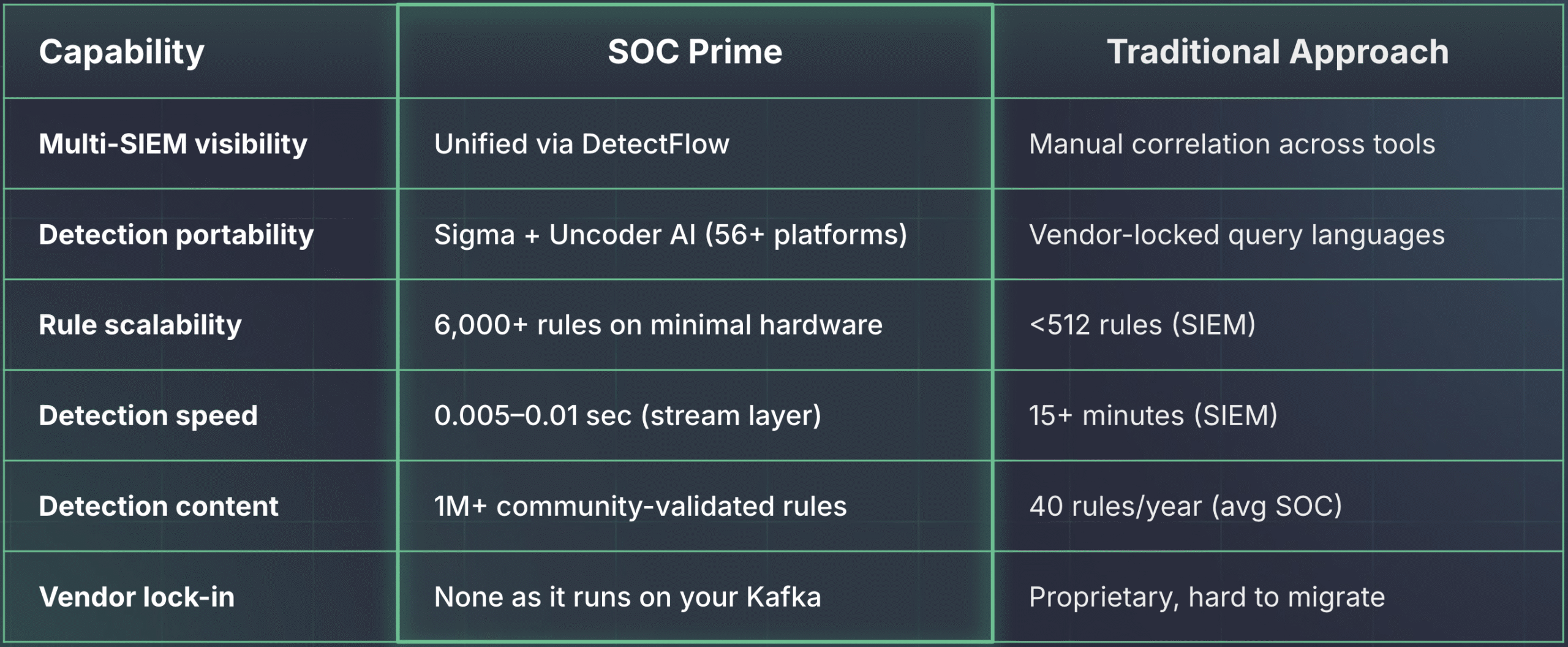
- Data arrives too late to be useful. SIEM-based detection is not instant. Events must be collected, parsed, ingested, indexed, and stored before they are reliably searchable and correlatable. In real environments, correlation can take 15+ minutes depending on ingestion and processing load. SDPPs reduce this gap by shaping telemetry in-flight so downstream systems receive cleaner, normalized events sooner, and by routing high-priority data on faster paths when needed.
- “Store everything” breaks the budget. Event data growth makes the default approach unaffordable. Even if you can pay to ingest everything, you still end up indexing and retaining huge volumes that do not improve detection outcomes. SDPPs help teams set clear policies, so high-value security events go to real-time systems, while bulk or long-retention logs are routed to cheaper tiers with predictable rehydration during investigations.
- Detection logic can’t keep up with log volume. Average SOCs deploy roughly 40 rules per year, while practical SIEM rule programs and performance limits often cap usable coverage in the hundreds. More telemetry lands, but detection content does not scale at the same pace. SDPPs close the gap by reducing noise, stabilizing schemas, and preparing data so each rule has a higher signal value and works more consistently across environments.
- ETL is not enough on its own. ETL is great for extracting, transforming, and loading data for analytics and reporting, often in batch. Security needs the continuous version of that idea. Telemetry arrives as a stream, formats change frequently, and detections need consistent schemas plus health monitoring to stay reliable. SDPPs complement ETL-style workflows by providing security-specific processing for streaming logs, schema drift handling, and operational observability.
- Threats iterate faster than your query budget. AI-driven campaigns can evolve malicious payloads in minutes, which punishes workflows that depend on slow query cycles and manual evidence stitching. SIEMs also impose practical ceilings, including hard caps like under 1,000 queries per hour, depending on platform and licensing. SDPPs help by making each query more effective through normalization and enrichment, and by reducing the need for brute-force querying via smart routing, filtering, and tagging upstream.
What Are the Benefits of a Security Data Pipeline Platform?
When security teams talk about “too much data,” they rarely mean they want less visibility. They mean the work has become inefficient. Analysts waste time stitching context together, detections break when schemas drift, and leaders end up paying for ingest that does not move risk down.
A Security Data Pipeline Platform changes the day-to-day reality by putting one layer in charge of how telemetry is prepared and where it goes. For SOC teams, that means events arrive cleaner, more consistent, and easier to investigate. For the business, it means you can scale detection and retention without turning SIEM spend and operational noise into a permanent paycheck.
Therefore, key benefits of using Security Data Pipeline Platforms include the following:
- Less noise, more signal. By filtering low-value events, deduplicating repeats, and adding context before events reach alerting systems, the SDPP helps analysts focus on what actually matters.
- Lower SIEM and storage spend. The pipeline controls what gets sent to expensive destinations, routing high-value events to real-time systems while pushing bulk telemetry to cheaper tiers.
- Less manual burden and rework. Transformation and routing rules live once in the pipeline instead of being rebuilt across tools and environments.
- Stronger governance and compliance. Centralized policies simplify privacy controls, data residency constraints, and retention rules.
- Fewer blind spots and surprises. Silence detection and telemetry health monitoring surface missing logs, drift, and delivery failures before incidents do.
How a Security Data Pipeline Platform Can Help Your Business?
At a business level, a Security Data Pipeline Platform is about making security operations predictable. When telemetry is governed upstream, leadership gets clearer answers to three questions that usually stay messy in mature environments: what data matters, where it should live, and what it should cost to operate at scale.
One practical impact is budget planning that survives data growth. Instead of treating ingestion as an uncontrollable variable, the pipeline makes volume a managed policy. You can set targets, prove what was reduced, and preserve the context that supports detection and compliance. That predictability turns cost reduction into operational freedom rather than a risky cut.
Another impact is standardization that unlocks reuse. When normalization is done once and applied everywhere, detection content and correlation logic can be reused across environments instead of being rewritten per source or per destination. That reduces the hidden maintenance costs that slow rollouts and drain engineering time.
A third impact is flexibility without lock-in. Intelligent routing and tiering let you align data to purpose, not vendor limitations. High-priority telemetry stays hot for response, broader datasets support hunting in cheaper stores, and long-retention logs can be archived with a clear rehydration path for investigations. The pipeline keeps the data layer stable while destinations evolve.
Finally, pipelines support operational assurance. Many organizations worry more about missing telemetry than noisy telemetry because quiet failures create blind spots that surface during incidents and audits. A pipeline that monitors source health and drift makes gaps visible early and improves confidence in security reporting.
Unlocking More SDPP Value With SOC Prime DetectFlow
Security data pipelines already help you collect, shape, and route telemetry with intent. SOC Prime’s DetectFlow adds an in-stream detection layer that turns your data pipeline into a detection pipeline. It runs Sigma rules on live Kafka streams using Apache Flink, tags, and enriches matching events in-flight, and routes high-priority matches downstream without changing your SIEM ingestion architecture.
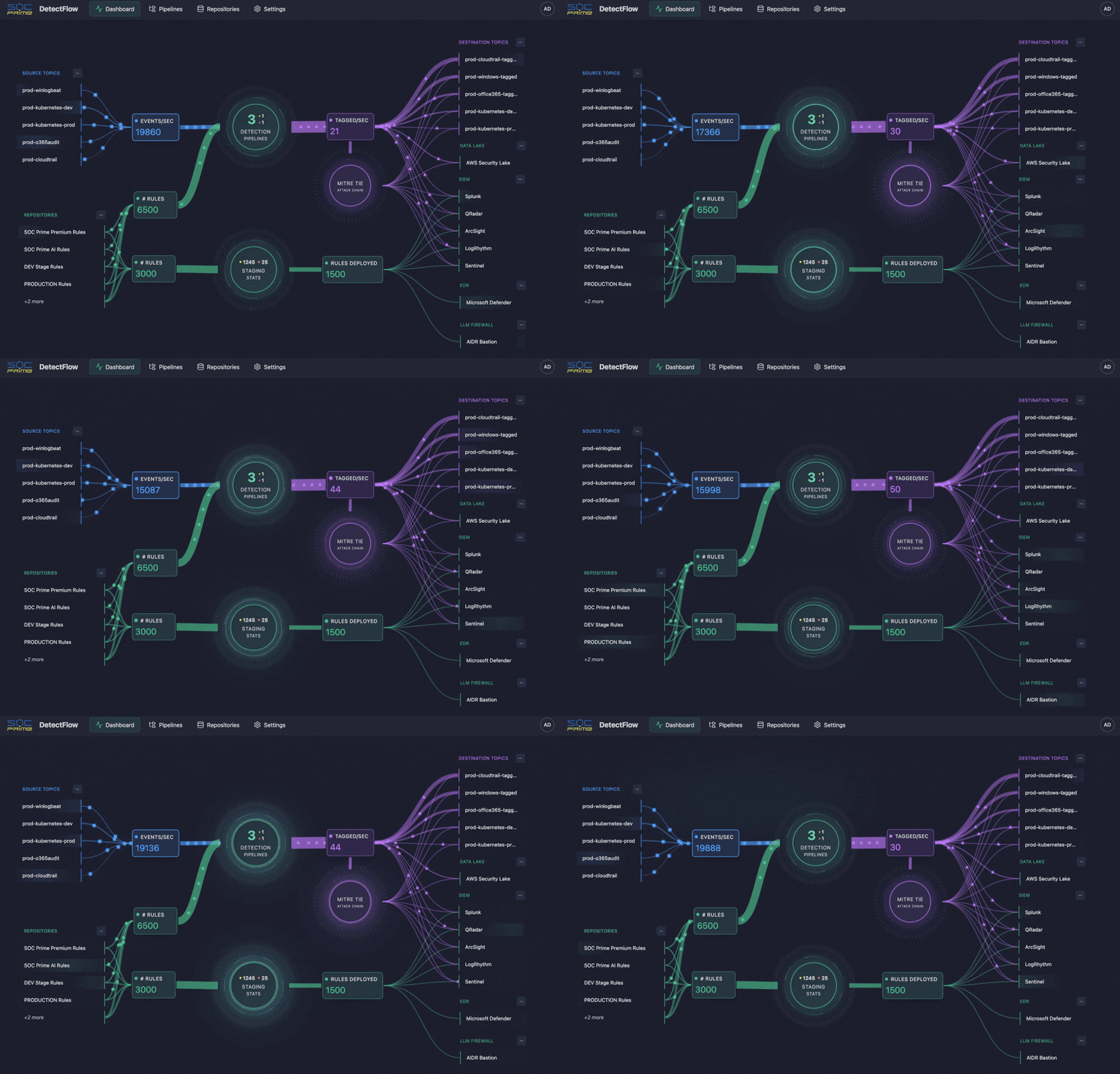
This directly targets the detection coverage gap. There are 216 MITRE ATT&CK techniques and 475 sub-techniques, yet the average SOC ships ~40 rules per year, and many SIEMs start to struggle around ~500 custom rules. DetectFlow is built to run tens of thousands of Sigma rules at stream speed with sub-second MTTD versus 15+ minutes common in SIEM-first pipelines. Because it scales with your infrastructure, you avoid vendor caps, keep data in your environment, support air-gapped or cloud-connected deployments, and unlock up to 10× rule capacity on existing infrastructure.
For more details, reach out to us at sales@socprime.com or kick off your journey at socprime.com/detectflow.