

 Follow
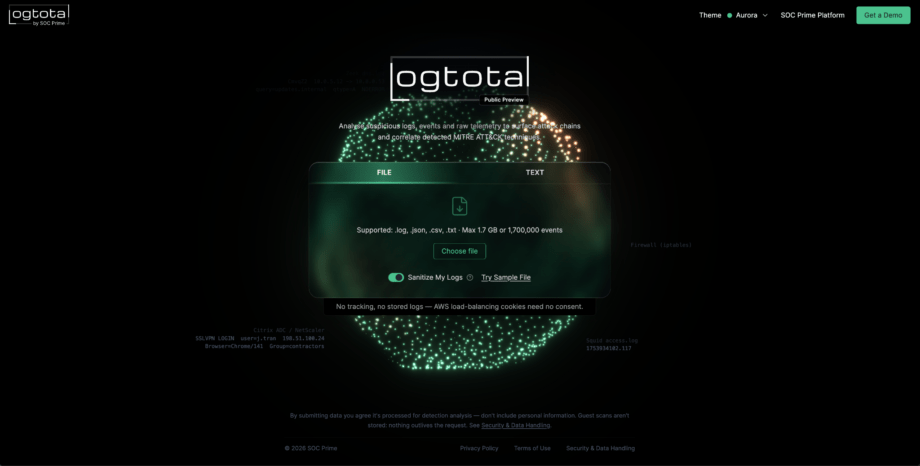
 Security teams don’t have a data shortage — they have a data flood. A single incident can throw off hundreds of thousands, sometimes millions, of log events, and making sense of them under time pressure is exactly the kind of work that breaks people and tooling alike. SOC Prime built LogTotal to take that pressure off, without asking teams to hand over the raw evidence to do it.
The problem: every “send us the logs” request is a privacy decision
Endpoint events, identity logs, cloud audit trails, syslog, Windows Event Logs, application JSON — this is the raw material of detection, hunting, and response. When something breaks, the first ask is almost always the same: send the logs.
That request used to stay inside a closed environment. Now it rarely does. Logs get attached to vendor tickets, dropped into collaboration tools, uploaded to SaaS analyzers, pasted into AI chat windows, copied into shared workspaces. Each hop widens the circle of people, systems, and jurisdictions that can see the original values.
The risk is easy to miss because logs look operational rather than confidential. In practice, one authentication event can carry a username, a source IP, a workstation name, a session cookie, and a bearer token in an Authorization header. A payment-adjacent log can contain a PAN-shaped number. A Windows file path can leak a home-directory username. A field labeled UserName or x-api-key often holds the value in plain text, even when the rest of the line looks harmless. Under GDPR and similar regimes, most of that counts as personal data — and a leaked token or key isn’t a historical record, it’s a live access path.
Refuse to share the logs and you slow down the investigation. Share them raw and you risk violating policy, contracts, or regulation. Manual redaction doesn’t scale, isn’t consistent across analysts, and often strips out the exact identifiers an investigation needs to correlate events.
This isn’t hypothetical. SOC Prime built LogTotal partly in response to HuggingFace’s July 2026 security incident, in which the team’s attempt to send roughly 17,000 events to frontier AI models was blocked by guardrails — forcing a fallback to a local GLM model with GPU and VRAM requirements most organizations simply don’t have. LogTotal is built to handle that same job — at up to 1,700,000 events — without anyone needing frontier-model access or a private GPU cluster.
Why simple redaction doesn’t hold up
Most redaction approaches fail in one of two directions.
Static masking — turning every IP into the same placeholder, every user into USER — destroys the thing that makes investigation possible: correlation. If ten failed logons all collapse to the identical token, you can no longer tell a single compromised account from a credential-spray attack hitting ten different people.
Plain find-and-replace fails the other way. It misses values in unusual encodings or nested JSON, and it over-redacts things that only look sensitive — version numbers shaped like IPs, UUIDs used as message IDs, well-known non-sensitive hostnames. Unkeyed hashing doesn’t solve it either: a raw hash of a common value can be reversed by dictionary-guessing, and identical unsalted hashes across different organizations can accidentally link unrelated incidents together.
LogTotal was built to avoid both failure modes.
How it actually works
- Sanitization happens locally, in your browser, before anything is sent anywhere. You can download the sanitized log at any point — you always have a clean copy of exactly what was analyzed.
- Your files never leave your control unsanitized, and nothing is stored. LogTotal doesn’t retain your logs after analysis, and SOC Prime has no need to — the platform isn’t training on your data.
- Upload in your native format. LogTotal auto-detects EVTX, CEF, JSON/NDJSON, and syslog — no manual conversion.
- Your sanitized events are correlated at scale. LogTotal runs them against roughly 1,000,000 detection rules and a dataset of 13,000 labels, then applies Higher Order Sigma Rules and agentic AI correlation to connect related events into a coherent picture — up to 1.7 million events, in under a minute.
- You get an investigation, not a dump. Results are structured as findings on the LogTotal site, not a wall of raw matches.
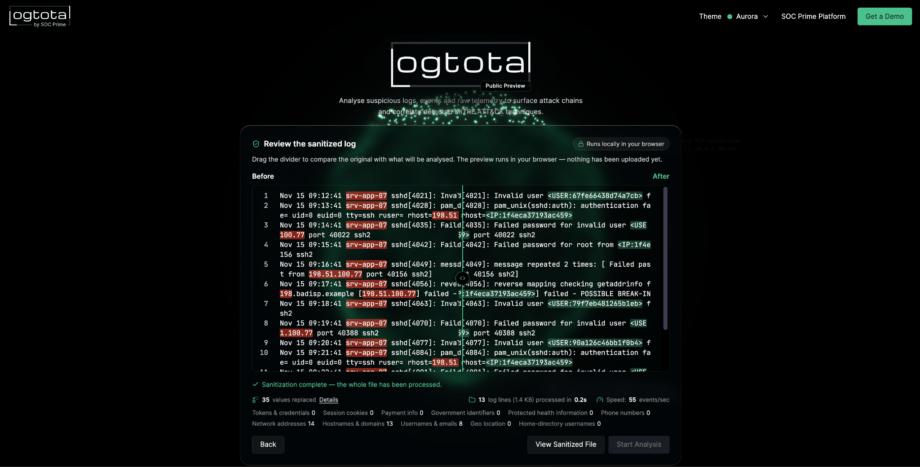
However, log sanitization is only the first stage of LogTotal once it’s out of the preview. Coming soon is something even more powerful: sanitized logs checked against tens of thousands of behaviour rules, with matches correlated around Higher Order Sigma rules for active threats.
Where teams can use this
- Incident response with external retainers. Sanitize a log packet with a key you retain. The retainer can still cluster hosts, users, and addresses — and you can map tokens back internally if a specific identity needs to be named in a privileged briefing.
- Vendor support and TAC cases. “The log file that shows the error” is famous for containing environment details unrelated to the ticket. Sanitizing before you attach it cuts accidental disclosure without turning the file into noise.
- Detection engineering and rule testing. Sample logs are how detections get written and validated — and how production identities leak into git history, CI artifacts, and demo environments. Sanitizing fixtures once, with a key shared inside the team, keeps examples correlatable while stripping secrets.
- Pre-SIEM or pre-lake sharing. Not every pipeline needs a commercial processor to redact a batch file. For exports, one-off hunts, and cross-team handoffs, a local sanitizer is the control people will actually use.
- GDPR and privacy reviews. Pseudonymization isn’t a blanket exemption, but replacing identifiers with keyed tokens before a file leaves the organization is a concrete technical measure — one you can point to and describe: what was removed, what was retained, how tokens were generated, who holds the key.
- AI-assisted analysis without exposing raw telemetry. Whether the destination is LogTotal, an internal model, or a restricted vendor environment, the question is the same: does the model need the actual password, or does it need to know a secret was present and the same user touched three hosts?
Try LogTotal
The SOC Prime Platform exists to help security teams anticipate, detect, validate, and respond to threats faster. That mission has never required collecting customer secrets. LogTotal extends it to private event analysis at community scale.
Security teams should not have to choose between a thorough investigation and a defensible data-handling story. Sanitize first. Correlate on tokens. Keep the key. Analyze the evidence that remains.
Explore LogTotal at https://logtotal.com.
Join the SOC Prime Platform to improve visibility into threats most relevant to your business. To help you get started and drive immediate value, book a meeting now with SOC Prime experts.







